
WELCOME BONUS 300%
UP TO €2000 + 100
FREE SPINS
UP TO €2000 + 100
FREE SPINS
Home → Blackjack
Blackjack at Thrill Casino
Even Money only possible with Dealer Ace
Blackjack Insurance carries an RTP of 92.53% and a house edge of 7.47%, and it can only be taken when the dealer shows an ace. The house edge is the average share of each stake the casino keeps, so for every €100 wagered on insurance the casino retains €7.47 on average. At a single deck the edge narrows to roughly 5.88%, which is still far above the 0.28% edge of Blackjack Liberal Vegas Strip.
Basic strategy declines insurance in every case, and the exception is card counters at a true count of +3 or higher. A 2:1 payout on a €10 side bet returns €20, yet the 7.47% edge means €100 of insurance stakes costs €7.47 on average. That cost is 26 times the 0.28% edge of the liberal Vegas Strip rule set, which is the most player-friendly configuration in the comparison.
Insurance is capped at 50% of the main bet, so a €10 main wager allows at most a €5 side bet. Where even money is offered against a dealer ace it settles the hand at 1:1 instead of the 3:2 blackjack payout, which on a €10 bet means €10 rather than €15. The 6:5 alternative is worse still at €12 on the same €10 stake.
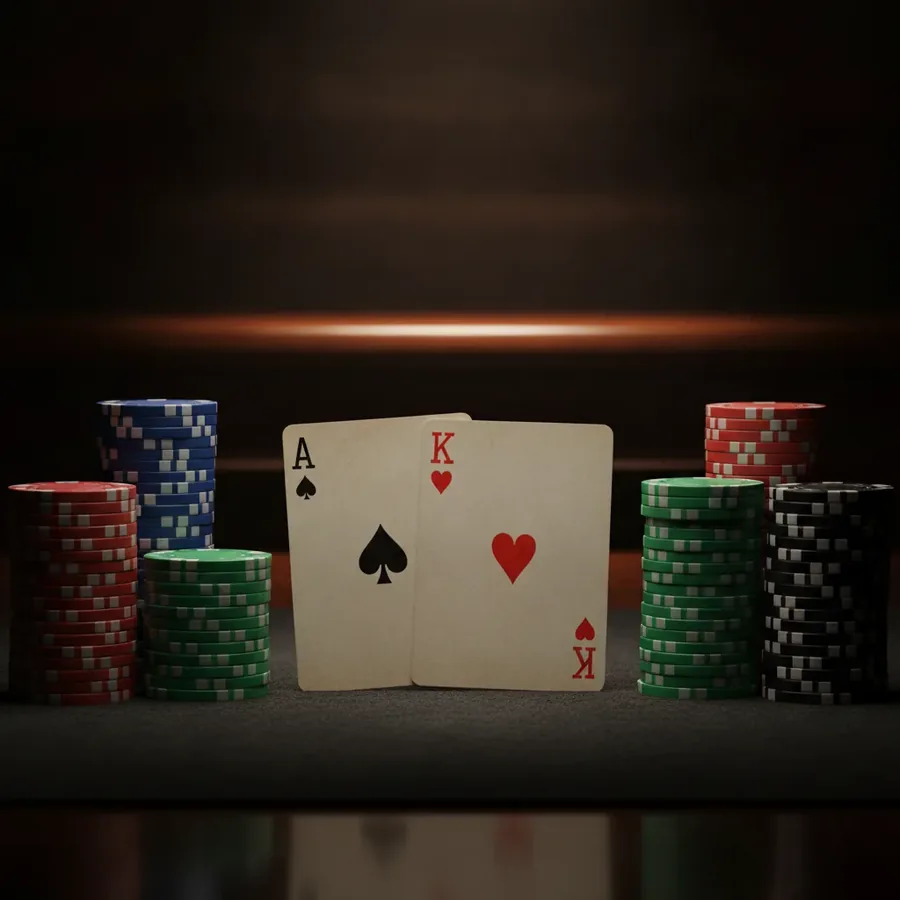
Calling Late Surrender Correctly in Three Steps
Late surrender is a rule modifier that cuts the house edge by 0.08 percentage points, and it returns 50% of the stake to the player. The player gives up the hand after the dealer has checked for blackjack, which removes the half of the stake that would otherwise be lost in full. Early surrender is worth up to 0.6 percentage points but is extremely rare.
The first step is to confirm the dealer has checked for blackjack, because surrender after that check is the only form that applies. The second step is to give up the hand before any hit, split or double, since those actions end the surrender option. The third step is to record the 50% return, so a €10 stake comes back as €5.
That €5 return compares with a full €10 loss on the same hand played out, so the rule saves €5 whenever the surrender is correct. Blackjack Liberal Vegas Strip includes late surrender alongside S17, DAS and resplit, and it reaches an RTP of 99.72% with a house edge of 0.28%. The surrender modifier alone accounts for 0.08 of those percentage points.
Soft 17: Does the Dealer Hit or Stand?
A dealer who hits soft 17 lowers RTP by 0.22 percentage points, which is the single largest rule cost in the split and double group. Blackjack 6 decks with S17, DAS, DOA and a 3:2 payout reaches an RTP of 99.54% and a house edge of 0.46%. Switching that same table to H17 pushes the edge to 0.68% and drops the RTP to 99.32%.
On €100 of stakes the H17 rule costs €0.22 more than S17, and over 1,000 rounds at €1 each the difference is €2.20. Resplitting aces improves the return by 0.08 percentage points, and doubling after a split by about 0.14 percentage points, so H17 outweighs both of those gains combined. Six decks instead of eight adds roughly 0.02 percentage points.
Blackjack Liberal Vegas Strip applies S17 together with DAS and resplit to reach its 0.28% house edge. Blackjack Single deck with classic rules and a 3:2 payout goes further, at an RTP of 99.85% and a house edge of 0.15%, because fewer decks lower the edge by about 0.48 percentage points against eight decks. A 6:5 payout would erase that advantage entirely.
Stop the Session After a 30 Percent Loss
A stop at 30% of the session bankroll is a threshold, not a game rule, and it is measured against the money brought to the table. On a €100 bankroll the stop sits at €30, which leaves €70 in play. The same 30% on a €500 bankroll is €150, and on a €1,000 bankroll it is €300.
The figure has to be read against the cost of play. At the 0.46% house edge of Blackjack 6 decks with S17, DAS, DOA and a 3:2 payout, €100 of stakes costs €0.46 on average, so €30 of expected loss represents roughly €6,521 of total stakes. At the 1.85% edge of a 6:5 table the same €30 is reached after about €1,622 of stakes, which is four times faster.
Live tables set their own limits: Infinite Blackjack runs from €1 to €5,000, Lightning Blackjack from €1 to €2,500, and Blackjack Party from €1.00 to €1,000. A 30% stop on a €1,000 session therefore sits at €300 regardless of which of those tables is used. The stop is checked against the bankroll, never against a single bet.
Double Down or Just Hit on 11
Doubling down doubles the stake and draws exactly one card, while a simple hit draws one card at the original stake. Doubling after a split improves RTP by about 0.14 percentage points, and the double itself is available on any first two cards in the 6-deck S17 configuration that reaches 99.54% RTP. A split can produce up to four hands, and split aces usually receive one card each.
On a €10 bet the double puts €20 at risk for one card, so a win returns €40 including the stake, against €20 for the same card taken as a simple hit. That €20 difference is the whole point of the double, and it is why the 0.14 percentage point gain applies only when the extra money goes down. The insurance side bet is capped at 50% of the main bet, which on that €10 wager is €5.
Blackjack variants at a glance
| Variant | Payout | House edge | Rule | RTP |
|---|---|---|---|---|
| Blackjack 6 decks, S17, DAS, DOA, 3:2 payout, basic strategy | Blackjack 3:2, regular win 1:1, insurance 2:1 | 0.46% | Dealer stands on soft 17; double down on any first two cards; doubling after a split allowed; no surrender. Basic strategy is required to reach this figure | 99.54% |
| Blackjack Insurance (6–8 decks) | Insurance 2:1 | 7.47% | Separate side bet of up to 50% of the main bet when the dealer shows an ace. Basic strategy ALWAYS declines it (except for card counters at a true count ≥ +3). With a single deck the edge is ≈ 5.88% | 92.53% |
| Blackjack 6:5 payout instead of 3:2 (6 decks) | Blackjack 6:5, win 1:1 | 1.85% | Replacing 3:2 with 6:5 adds exactly +1.39 percentage points to the casino's edge – more than any other rule change. On a €10 bet a blackjack pays €12 instead of €15. | 98.15% |
| Blackjack Split / double / H17 – rule effects | Double – stake ×2 with one card; split – up to 4 hands; split aces usually get one card each. | H17 +0.22 percentage points; RSA −0.08 percentage points; DAS −0.14 percentage points | Dealer hitting soft 17 lowers RTP by 0.22 percentage points; resplitting aces improves it by 0.08 percentage points; doubling after a split improves it by about 0.14 percentage points; 6 decks instead of 8 – about 0.02 percentage points. | n/a (rule modifiers) |
| Blackjack Liberal Vegas Strip (liberal rules, 3:2) | Blackjack 3:2, win 1:1 | 0.28% | The most player-friendly rule set: S17 + DAS + resplit + late surrender. Standard deviation 1.15 | 99.72% |
| Blackjack Single deck, classic rules, 3:2 | Blackjack 3:2, win 1:1 | 0.15% | Fewer decks = lower edge; one deck gives about −0.48 percentage points compared with 8 decks. Often offset by a 6:5 payout. | 99.85% |
When Can You Raise Your Bet?
Increasing the bet is permitted where the table rules allow a double, and the standard double commits a second stake equal to the first in exchange for exactly one additional card. At a bet range of 1 - 2,500 EUR, as offered in Lightning Blackjack from Evolution, a doubled €10 hand ties up €20 in total. Doubling after a split is a separate permission, and it improves the return by about 0.14 percentage points.
Splitting is the other route to a larger exposure: up to four hands can be created from one starting hand, and split aces usually receive one card each. Resplitting aces is worth 0.08 percentage points of return, while the dealer hitting soft 17 costs 0.22 percentage points. A player who splits three times can have four stakes of €10 running at once, so €40 is at risk instead of €10.
Blackjack Surrender, played as late surrender, reduces the house edge by 0.08 percentage points and returns 50% of the stake, but it ends the hand rather than enlarging it. Insurance is not an increase in the main bet: it is a separate side bet of up to 50% of the main bet when the dealer shows an ace, so a €10 hand can carry €5 of insurance money.
16 vs 10 played incorrectly: most common error
A hard 16 against a dealer 10 is the position where basic strategy is abandoned most often, because the hand is played on feel rather than on the rule set. The 6-deck benchmark with S17, DAS, DOA and a 3:2 payout returns 99.54% with a house edge of 0.46%, and that figure assumes basic strategy is followed on every hand. In other words, the 0.46% is the price of correct play, not of intuitive play.
The cost of a single wrong decision is small, but it accumulates: at a €10 stake the house edge of 0.46% equals about €0.05 per hand on average, while the 6:5 payout version carries 1.85% and takes roughly €0.19 per €10 hand. Replacing 3:2 with 6:5 adds exactly 1.39 percentage points to the casino's edge, more than any other single rule change. On a €10 bet a blackjack then pays €12 instead of €15.
Blackjack Liberal Vegas Strip shows what a player-friendly rule set looks like: S17, DAS, resplit and late surrender give 99.72% RTP against a house edge of 0.28%, with a standard deviation of 1.15. The gap to the 6:5 game is 1.57 percentage points of return, which on 100 € of stakes is the difference between losing about 0.28 € and about 1.85 € on average.
Bet Two Percent of Your Bankroll per Hand
A stake of 2% of the bankroll on a €500 balance is €10 per hand, and that unit can be measured against the table limits actually in force. Infinite Blackjack from Evolution accepts 1 - 5,000 EUR per hand, so €10 sits comfortably inside the range, while Blackjack Party from Evolution runs from 1.00 EUR to 1,000 EUR and Lightning Blackjack from 1 to 2,500 EUR.
Sizing the unit this way keeps the theoretical cost predictable. On the 6-deck game with S17, DAS, DOA and a 3:2 payout, RTP is 99.54% and the house edge is 0.46%, so 100 € of stakes cost about 0.46 € on average. A player staking €10 per hand therefore pays roughly €0.05 per hand in expectation, and 100 hands at that unit move about €1,000 of turnover.
The single-deck classic with a 3:2 payout is the cheapest rule set on the list at 99.85% RTP and a 0.15% house edge, where €1,000 of turnover costs about €1.50 on average. That game is often offset by a 6:5 payout, which lifts the edge to 1.85% and turns the same €1,000 of turnover into about €18.50 of expected cost.
The Insurance Mistake: 7% Extra House Edge
Insurance is a separate side bet of up to 50% of the main bet when the dealer shows an ace, and with 6 to 8 decks it returns 92.53% against a house edge of 7.47%. It pays 2:1, so a €10 hand with the maximum €5 insurance returns €15 on the side bet when the dealer holds blackjack. Basic strategy always declines it, except for card counters at a true count of +3 or higher.
The 7.47% edge is far above the main game: the 6-deck benchmark with S17, DAS, DOA and a 3:2 payout carries 0.46%, which makes insurance roughly sixteen times more expensive per euro staked. A single deck lowers the insurance edge to about 5.88%, but the side bet remains the worst-priced wager at the table. On €100 of insurance stakes the average cost is €7.47.
Insurance also interacts with the main bet rather than replacing it. A €10 hand with €5 of insurance risks €15 in total, and a blackjack on the main hand pays the usual 3:2, which is €15. The side bet only breaks even on the player's side when the dealer actually holds a ten-value card underneath the ace.
Soft vs Hard Hands in Practice
An ace counted as 11 produces a soft hand, while the same ace counted as 1 produces a hard hand; the distinction decides whether a further card can bust the player. Blackjack 6 decks, S17, DAS, DOA, 3:2 payout, basic strategy carries an RTP of 99.54% and a house edge of 0.46%, and the house edge here means the average share of each stake that the casino keeps.
Under that rule set the dealer stands on soft 17, so a soft 17 held by the player can be improved without the same risk that applies when the dealer hits soft 17; dealer hitting soft 17 lowers RTP by 0.22 percentage points. Doubling after a split is allowed and improves the return by about 0.14 percentage points, which is why the soft-hand decision differs between rule sets.
Insurance is a separate side bet of up to 50% of the main bet when the dealer shows an ace, pays 2:1, and runs at an RTP of 92.53% with a house edge of 7.47%; basic strategy always declines it except for card counters at a true count of at least +3. On a €100 main bet the insurance stake of up to €50 therefore costs about €3.74 on average across many rounds.
Which Rule Variants the Software Shows
Blackjack Liberal Vegas Strip combines S17 with DAS, resplit and late surrender and reaches an RTP of 99.72% against a house edge of 0.28%. Against Blackjack 6 decks, S17, DAS, DOA at 99.54%, the liberal rule set keeps 0.18 percentage points less of every stake, so €100 of stakes costs €0.28 on average instead of €0.46.
At the other end, replacing a 3:2 payout with 6:5 on six decks drops the RTP to 98.15% and lifts the house edge to 1.85%, an addition of exactly 1.39 percentage points. That single change is larger than any other rule variation, so a €10 bet returns €12 instead of €15 on a blackjack.
Late surrender is available as a rule modifier: the player gives up the hand after the dealer has checked for blackjack and loses half the stake, which improves RTP by about 0.08 percentage points and moves the house edge by −0.08 percentage points. Early surrender is worth up to −0.6 percentage points but is extremely rare, and a single deck at classic rules reaches 99.85% RTP with a 0.15% house edge.
Clicked Too Late? The Hand Stands Automatically
Infinite Blackjack from Evolution runs at an RTP of 99.47% with unlimited seats at the table and four side bets: Any Pair, 21+3, Hot 3 and Bust It. A side bet is a wager placed on a supplementary outcome alongside the main hand, and the bet range of 1 € - 5,000 € sets how far a single decision can be scaled.
Where the decision window closes before the player acts, the hand is held as it stands and the round is settled at that value. Blackjack 6 decks, S17, DAS, DOA, 3:2 payout, basic strategy reaches 99.54% only when basic strategy is applied to every decision, so a held hand that departs from basic strategy gives up part of that 0.46% house edge advantage.
The 3:2 Blackjack Payout Explained
A 3:2 blackjack payout pays 150 € on a 100 € stake, while 6:5 pays only 120 € on the same stake; Blackjack 6 decks, S17, DAS, DOA carries the 3:2 payout and reaches 99.54% RTP with a 0.46% house edge. Regular wins pay 1:1 and insurance pays 2:1 alongside the blackjack bonus.
The 6:5 variant on six decks sits at 98.15% RTP and a 1.85% house edge, which is 1.39 percentage points more for the casino than the 3:2 version. On a €10 bet the difference is visible directly: €15 under 3:2 against €12 under 6:5, a shortfall of €3 per blackjack.
Blackjack Liberal Vegas Strip keeps the 3:2 payout together with S17, DAS, resplit and late surrender at 99.72% RTP and a 0.28% house edge. The standard deviation of that rule set is 1.15, and a single deck at classic rules with 3:2 reaches 99.85% RTP with a 0.15% house edge, though a 6:5 payout often offsets that gain.
Split Aces: Only One Card per Hand
Splitting aces usually gives each hand one card only, and resplitting aces improves RTP by 0.08 percentage points; a split can produce up to four hands. Doubling after a split is a separate modifier worth about 0.14 percentage points, and the two rules do not apply to split aces in the same way.
Blackjack 6 decks, S17, DAS, DOA, 3:2 payout, basic strategy reaches 99.54% RTP with a 0.46% house edge, and doubling after a split is part of that figure. Removing the resplit of aces from the same rule set lowers the return by 0.08 percentage points, which on €100 of stakes is €0.08 of expected value.
Infinite Blackjack from Evolution offers unlimited seats at 99.47% RTP with a bet range of 1 € - 5,000 €, and Blackjack Party from the same studio carries a bet range of 1.00 € - 1,000 €. On a €100 stake, the 0.46% house edge of the six-deck game costs €0.46 on average, while the single-deck classic rule set at 0.15% costs €0.15.
Contact
Live - online chat
Banking









Providers












Thrill Casino 2026